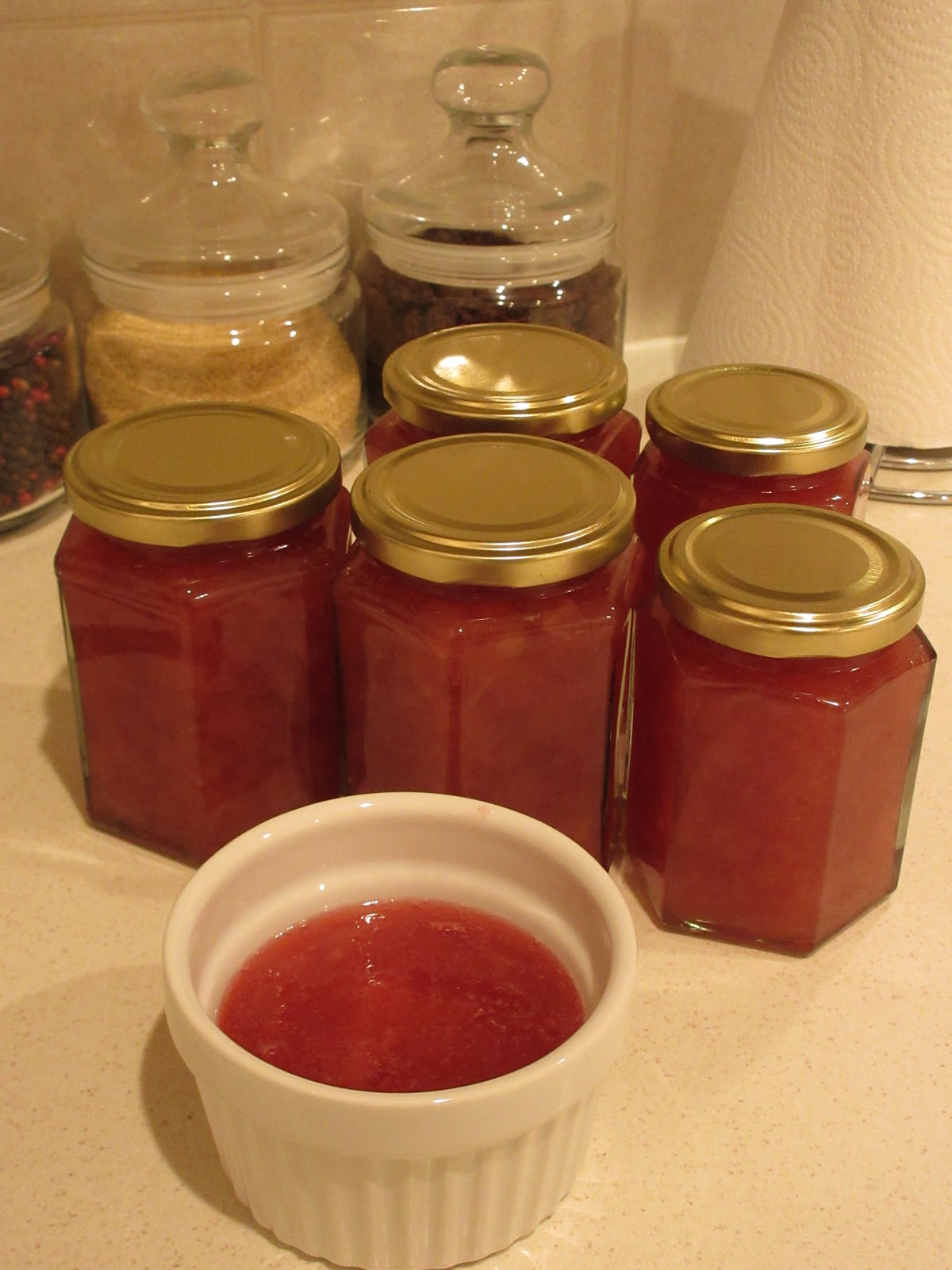
With a bagful of Victoria Plums from friends, I quickly looked through recipe books and also my own recipes, and devised a different one to use up a Kilo of prepared plums.
To prepare the plums, I wash them first, then as they need to be chopped up, I select the more variable in size and shape and ones that may have small blemishes, since these can be eliminated. Its the completely prepared fruit which had had the stones removed, and pieces cut out that are weighed to make up the chutney. Each plum is cut into about 8 pieces.
I now store all my fresh ginger in the freezer. Having first washed and brushed it, I cut up the large rhizomes into pieces about two centimeters long, and open freeze it, then put them all in a tub in the freezer. There is now always ginger ready to hand, and from frozen it cuts up very easily into whatever size pieces are needed. I like to use the dry dates and keep the lovely soft ones for eating fresh with nuts.
Ingredients
1Kg prepared plums
350g cooking onions, peeled and chopped
50g prepared fresh/frozen ginger
100g dried pitted dates
1 tsp ground cinnamon
1 tsp ground turmeric
1 tbsps cumin seeds, dry roasted and slightly crushed
300ml organic cider vinegar
100g soft brown sugar, preferably Billington's Light Muscovado from Mauritius
Add all of the above to a large very thick bottomed pan, stir over a moderate heat, bring to the boil, then reduce the heat, and continue to cook gently, stirring regularly, to make sure that that nothing is sticking at the bottom of the pan. The chutney should be thick and pulpy, but do bear in mind that it thickens further as it cools.
Sterilized your jars and have them hot and ready from the oven, then ladel in the chutney using a jamming funnel, cover quickly with a new and clean top, check that the tops are wells sealed down. When cool, label, and set by in a cool dark cupboard and wait......two to three months at least.
This chutney is wonderful with cold cuts of meat, on the side with vegetable bakes, macaroni cheese etc.
To anyone who is a newby to chutney making, I say:
" Taste the chutney when cool enough, by all means. However, it is only two, three, or even six months down the line that the lovely depths of flavour start to be produced. Think of the chutney as a red wine or a port that develops over time. Chutney is a lovely way of capturing ingredients when they are at their best, preserving them in a sealed and hygienic environment, then with time you realise that you have created something that is greater than the sum of the original ingredients."
By all means use whatever variety of plums you have to use....
Sunday, 26 August 2018
Monday, 16 April 2018
Lime Marmalade several ways using the Pressure Cooker
Have I mentioned before that I like marmalade? And how many times have I used limes? Lots for sure. We have a lovely vegetable and fruit sellers just once a week on a Thursday a few miles outside of Wells, at the Rocky Mountain Plant Nursery.
I went up there this Thursday on the off chance of getting some things from the nursery, and had a peep in at fruit and vegetable stall. Readers it would have been completely rude of me not to take on the offer of a whole box of limes. I still cannot believe that I paid very nearly the same as for a small bag from a supermarket, and there was no plastic whatsoever. OK they were not the bright dark green variety. They were an even colour, some were slightly green but most were more yellow. Maybe they did not quite make the price at the wholesale market because of this. They had come all the way from South America and because they were yellowish I guess they must have been picked ripe or were a different variety. They were firm, smooth, and may have even been Meyer Limes. They taste like limes, are very juicy and have no pips whatsoever.
With my first Kg I made a batch of lime marmalade following Dan Lepard's Recipe but with the addition of a few crushed gin berriers. With the same proportion of raw limes as weight in sugar this makes a very fruity and zesty marmalade.
For the second batch of another Kilogram of limes, I devised my own recipe to include fresh chopped ginger and whole cardamom. I have used both ginger and cardamom before and really love the twist they bring. To the 1Kg fruit I added 1.5Kg sugar this time.
For both batches I followed the same procedure for cooking up the fruit:
1 Litre water to 1 Kilo of Fruit
Wash the fruit well in warm water.
Half the fruit, squeeze out the juice, which is stored in a jug in the fridge and used later.
Cut the halved limes into two, still with their pith and membrane, and soak the quarter peels in 1 litre of fresh cold water. Keep the fruit submerged by putting a plate smaller than the bowl on them, and leave to soak overnight in a glass bowl.
The next day transfer the peels and water to a pressure cooker, and cook at 12lbs for 10 minutes.
When the pressure has cooled down naturally, and the peel is cool enough to handle, stain it from the liquid over another bowl, catching the liquid.
Remove the membranes with a small spoon, and cut the peel up finely.
Return the chopped peel with the draining cooking liquid to the pressure cooker. At this stage add whatever spices, bring to the boil and pressure cook for a further 5 minutes. Allow the pressure to drop naturally.
In the meantime, pass as much of the removed membranes and tissues through a sieve as you can.
Measure your sugar, add this and the sievings of the membrane, the cold juice from the fridge, and the spices to the contents of the pressure cooker. You can boil this quantity in a large pressure cooker, without the weights and lid, but I prefer to boil up the marmalade in my larger preserving pan.
I used both a thermometer and wrinkle test to gauge when the marmalade is set.
From the 1Kg of Fruit and 1.5Kg of sugar I got 8 large jars
From the .9Kg of fruit and sugar I got 3 large and 3 medium jars of Lime and juniper Marmalade.
I went up there this Thursday on the off chance of getting some things from the nursery, and had a peep in at fruit and vegetable stall. Readers it would have been completely rude of me not to take on the offer of a whole box of limes. I still cannot believe that I paid very nearly the same as for a small bag from a supermarket, and there was no plastic whatsoever. OK they were not the bright dark green variety. They were an even colour, some were slightly green but most were more yellow. Maybe they did not quite make the price at the wholesale market because of this. They had come all the way from South America and because they were yellowish I guess they must have been picked ripe or were a different variety. They were firm, smooth, and may have even been Meyer Limes. They taste like limes, are very juicy and have no pips whatsoever.
With my first Kg I made a batch of lime marmalade following Dan Lepard's Recipe but with the addition of a few crushed gin berriers. With the same proportion of raw limes as weight in sugar this makes a very fruity and zesty marmalade.
For the second batch of another Kilogram of limes, I devised my own recipe to include fresh chopped ginger and whole cardamom. I have used both ginger and cardamom before and really love the twist they bring. To the 1Kg fruit I added 1.5Kg sugar this time.
For both batches I followed the same procedure for cooking up the fruit:
1 Litre water to 1 Kilo of Fruit
Wash the fruit well in warm water.
Half the fruit, squeeze out the juice, which is stored in a jug in the fridge and used later.
Cut the halved limes into two, still with their pith and membrane, and soak the quarter peels in 1 litre of fresh cold water. Keep the fruit submerged by putting a plate smaller than the bowl on them, and leave to soak overnight in a glass bowl.
The next day transfer the peels and water to a pressure cooker, and cook at 12lbs for 10 minutes.
Remove the membranes with a small spoon, and cut the peel up finely.
Return the chopped peel with the draining cooking liquid to the pressure cooker. At this stage add whatever spices, bring to the boil and pressure cook for a further 5 minutes. Allow the pressure to drop naturally.
In the meantime, pass as much of the removed membranes and tissues through a sieve as you can.
Measure your sugar, add this and the sievings of the membrane, the cold juice from the fridge, and the spices to the contents of the pressure cooker. You can boil this quantity in a large pressure cooker, without the weights and lid, but I prefer to boil up the marmalade in my larger preserving pan.
I used both a thermometer and wrinkle test to gauge when the marmalade is set.
From the 1Kg of Fruit and 1.5Kg of sugar I got 8 large jars
From the .9Kg of fruit and sugar I got 3 large and 3 medium jars of Lime and juniper Marmalade.
Saturday, 20 January 2018
Early Rhubarb Jam
On Thursday Maggie asked if I would like a ride up to Fruit and Veg stall at the Rocky Mountain Nurseries about three miles from Wells. We were going up to get oranges, lemons etc for a great marmalade making spree next week. We are going to make marmalade to raise funds for the refurbishment of the Chapel at the Wells Almshouses.
It is almost like going to a wholesalers, as the owners buy the best in season, and sell off whole boxes of fruit and veg at very competitive prices. We bought a whole box: (cardboard) of fine but 'ungraded' forced rhubarb for £5 to split...this is just half a box! It was towards the end of the day so I think we arrived close to the final sell off.
After washing and preparing the stems, I had 1.75Kg, but by then was too tired to start cooking...
By yesterday evening I had looked through recipe books and had plans not only for the 1Kg of rhubard that went into the jam, but had also made a rhubarb crumble and an almond and spelt cake with chopped rhubarb in it.
For the jam, the rhubarb was chopped up, and layered with 900g granulated sugar to which I had added a sachet of powdered apple pectin, the juice and the rind of an orange...
After several hours of trying to get back to sleep, and no results, I was up at 5 a.m this morning, and found that the sugar has pulled out a lot of the juice leaving the little pieces of rhubarb bobbing around near the surface. So is this doubly early Rhubarb Jam?
This is the first time I have bought the very early rhubarb, and wanted to make a very simple preserve. Last year I made a double ginger rhubarb jam as well as a rhubarb, fig and orange jam from garden grown rhubarb.
Grapefruit and cardamom marmalade
There is a much easier way of weighing grapefruits, but sometimes a little fun creeps into my preserving.
I was thinking back to our holiday last year in La Gomera.....
Making marmalade in stages allows for time, which helps with the softening the peel, allowing the pectin to seep into the water.
I followed my now trusted formula for marmalade, using the ratios of 1 litre water to 1 Kg fruit to 1.5 Kg Sugar, with the juice of 3 to four lemons.
For this preserve, I added the lemon peel to the grapefruit peel for the soaking.
I leave the rind in these long segments for the soaking and cooking at pressure, then cut them up finely after the pan has returned to room temperature naturally, often on the following day. It is then soft and very easy to cut up.
Before it is cooked, the flesh and pips which I removed before cutting up the rind, also go into the soaking liquid overnight.
The lemon juice only goes in when the sugar is added and the preserving pan is brought to the boil.
As I enjoyed the Pear, Lemon, Lime and cardamom marmalade which is just coming to an end, I decided to add some cardamom to this grapefruit marmalade. I think the P L L & C marmalade is my favourite flavour in the marmalade field. I have made several Grapefruit marmalades since I started this blog, but it has always been using pink grapefruits.
I leave the crushed whole pods to boil up in the pan, but remove the husks and leave the seeds whole in the finished marmalade.
I have only just today made up labels, and the jars are now nestling in the preserve cupboard in the newly decorated utility room. All except for one which I have already given to a friend.
Saturday, 7 October 2017
Pear Lemon and Lime Marmalade with cardamon
Its that time of the year again...Pear season. We came away from visiting our dearly beloveds with a large basket of pears. With pears there is the day they are perfect, and then afterwards it is a fast decline. With a few set down in the freezer poached in port and vanilla, its time to come up with some preserves for the store cupboard.
Back in 2013, I made a delicious Pear and Lemon Marmalade. I wanted to make a preserve this morning, but only had three organic lemons in 'store', and with it being cold and miserable, just did not want to go out to get more. There were some organic limes ready for a desert, so a few of them were commandeered to join the preserve.
At knitting on Thursday Maggie was explaining a 'Victorian' Christmas cake recipe, where everything was made in the same pan, to avoid as much washing up as possible! Well they did not have running hot water and detergents, and washing up must have been quite a chore. I can hear Mr M saying 'it still is'. Well he is away, and it is I who will be doing all the washing up.
This marmalade was therefore all made in the same pan: the pressure cooker.
I took 400g combined weight lemon and limes, first carefully washed, then chopped them into quarters, extracted the juice, then put the fruit skins and pips and cooked them for 12 minutes at full pressure with 500ml of water. Meantime I skinned and chopped 800g pears, and tossed them in the remaining lemon and lime juice.
When the peel was sufficiently cool, after the membranes were scrapped off, the peel with all its pith still attached was finely chopped. ( The last little detail was added for Jason who asked the question). The pith really turns to a soft jelly like edge to the peel, and gives a good mouth feel in the final marmalde.
Thchopped peel was then put back into the pressure cooker with the chopped pear, and brought to pressure for another five minutes. Meanwhile I pushed the pulp which includes the internal juicy parts of the lemons and limes, the scrapping and pips through a sieve, and this was then added with 650g sugar, to the pressure cooker as soon as it was cool enough to open. You are left with just a the pips and the bits which could not pass the sieve which go in the bin. This is when the tablespoon of cardamon pods are added. I had thought of adding juniper berries as I had done with Lime Marmalade once...maybe another time.
The next stage of boiling up the marmalade was done with the lid off!!!! Towards the end of cooking when the temperature was about 103 C I fished out the pods, and using two forks, to prevent burning, I squidged out the seeds which went back in the pan, then just within few minutes and the magic 105 C was reached.
Of course the marmalade is rather fruity, but with just 650g sugar there are only two medium and two large jars.
All that chopping and washing up for just four jars....it will be worth it, I hope!
Back in 2013, I made a delicious Pear and Lemon Marmalade. I wanted to make a preserve this morning, but only had three organic lemons in 'store', and with it being cold and miserable, just did not want to go out to get more. There were some organic limes ready for a desert, so a few of them were commandeered to join the preserve.
At knitting on Thursday Maggie was explaining a 'Victorian' Christmas cake recipe, where everything was made in the same pan, to avoid as much washing up as possible! Well they did not have running hot water and detergents, and washing up must have been quite a chore. I can hear Mr M saying 'it still is'. Well he is away, and it is I who will be doing all the washing up.
This marmalade was therefore all made in the same pan: the pressure cooker.
I took 400g combined weight lemon and limes, first carefully washed, then chopped them into quarters, extracted the juice, then put the fruit skins and pips and cooked them for 12 minutes at full pressure with 500ml of water. Meantime I skinned and chopped 800g pears, and tossed them in the remaining lemon and lime juice.
When the peel was sufficiently cool, after the membranes were scrapped off, the peel with all its pith still attached was finely chopped. ( The last little detail was added for Jason who asked the question). The pith really turns to a soft jelly like edge to the peel, and gives a good mouth feel in the final marmalde.
Thchopped peel was then put back into the pressure cooker with the chopped pear, and brought to pressure for another five minutes. Meanwhile I pushed the pulp which includes the internal juicy parts of the lemons and limes, the scrapping and pips through a sieve, and this was then added with 650g sugar, to the pressure cooker as soon as it was cool enough to open. You are left with just a the pips and the bits which could not pass the sieve which go in the bin. This is when the tablespoon of cardamon pods are added. I had thought of adding juniper berries as I had done with Lime Marmalade once...maybe another time.
The next stage of boiling up the marmalade was done with the lid off!!!! Towards the end of cooking when the temperature was about 103 C I fished out the pods, and using two forks, to prevent burning, I squidged out the seeds which went back in the pan, then just within few minutes and the magic 105 C was reached.
Of course the marmalade is rather fruity, but with just 650g sugar there are only two medium and two large jars.
All that chopping and washing up for just four jars....it will be worth it, I hope!
Friday, 8 September 2017
Somerset Courgette and Apple Chutney
This is a new Chutney Recipe, devised to have a truly local chutney. In what sense local? Is it traditional....most probably not! It does contain courgettes grown in my garden, and apples from Andrew opposite, and local Somerset Cider from Honey Pot Farm. Organic onions bought locally and soft brown sugar from Mauritius.
Ingredients
1Kg small courgettes chopped to the size you would like to have in the chutney
500g cooking apples
600g brown onions, chopped small
6 cloves of garlic cut into slithers
500g soft brown sugar
700g organic cider vinegar
1.5 tbs cornflour
Spices:
1 tbsp ground turmeric
1 tsp whole coriander seeds
1 tsp cumin seeds
2 tsp fenugreek
1 tsp ground allspice
1 tsp celery seeds
3 tsp light mustard seeds
1/2 tsp cinnamon
1 chilli, chopped small.
Chop the courgettes, and put them in a bowl and toss with 1 tbs sea salt, and leave whilst you prepare the following, which allows for water to be drawn out. Just before adding them to the preserving pan, put into a colander and press down to remove any liquid.
In your preserving pan, or large pan, or pressure cooker base, warm the vinegar and add all the spices...keep this on a very low heat whilst you chop the ingredients: Chop the apples small and the onion and garlic...putting them in the vinegar as you go along. Remove a few tablespoon of the vinegar to a small dish or cup, and when cool stir in the cornflour.
Add the soft brown sugar to the preserving pan and stir until dissolved. Boil up and then simmer gently for about five minutes, then add the drained courgettes. Heat up till boiling again then reduce to a simmer for another five minutes or so. I like a tiny bit of bite to the vegetables, so keep an eye on the timings and the texture, stirring from time to time.
Add the cornflour to the pan, and stir carefully throughout the chutney, and the whole lot should be nicely thickened, but it will thicken more on cooling.
Pot up into sterilized jars. I do this by washing the jars and rinsing them, then placing them in an oven at about 100 C for fifteen minutes. The lids I add to a basin, add boiling water to cover, and place this in the oven at the same time. I like to add the chutney to warmed jars, but the lids need to be dried off with a clean kitchen towel.
I love the way that by making chutneys, one can transform and preserve fruit and vegetables to make a tasty condiment, to be put in store, and used later. Using up plentiful local ingredients is one of the pleasures of preserving....living in a county where the art of cider vinegar making is being continued by even small orchard and cider makers, it would be remiss not to seek out different ones. My current batch of chutneys are from a cider vinegar which is truly fruity. I am sure that cider vinegars change from year to year, and from maker to maker and I look forward to seeking out different ones.
Ingredients
1Kg small courgettes chopped to the size you would like to have in the chutney
500g cooking apples
600g brown onions, chopped small
6 cloves of garlic cut into slithers
500g soft brown sugar
700g organic cider vinegar
1.5 tbs cornflour
Spices:
1 tbsp ground turmeric
1 tsp whole coriander seeds
1 tsp cumin seeds
2 tsp fenugreek
1 tsp ground allspice
1 tsp celery seeds
3 tsp light mustard seeds
1/2 tsp cinnamon
1 chilli, chopped small.
Chop the courgettes, and put them in a bowl and toss with 1 tbs sea salt, and leave whilst you prepare the following, which allows for water to be drawn out. Just before adding them to the preserving pan, put into a colander and press down to remove any liquid.
In your preserving pan, or large pan, or pressure cooker base, warm the vinegar and add all the spices...keep this on a very low heat whilst you chop the ingredients: Chop the apples small and the onion and garlic...putting them in the vinegar as you go along. Remove a few tablespoon of the vinegar to a small dish or cup, and when cool stir in the cornflour.
Add the soft brown sugar to the preserving pan and stir until dissolved. Boil up and then simmer gently for about five minutes, then add the drained courgettes. Heat up till boiling again then reduce to a simmer for another five minutes or so. I like a tiny bit of bite to the vegetables, so keep an eye on the timings and the texture, stirring from time to time.
Add the cornflour to the pan, and stir carefully throughout the chutney, and the whole lot should be nicely thickened, but it will thicken more on cooling.
Pot up into sterilized jars. I do this by washing the jars and rinsing them, then placing them in an oven at about 100 C for fifteen minutes. The lids I add to a basin, add boiling water to cover, and place this in the oven at the same time. I like to add the chutney to warmed jars, but the lids need to be dried off with a clean kitchen towel.
I love the way that by making chutneys, one can transform and preserve fruit and vegetables to make a tasty condiment, to be put in store, and used later. Using up plentiful local ingredients is one of the pleasures of preserving....living in a county where the art of cider vinegar making is being continued by even small orchard and cider makers, it would be remiss not to seek out different ones. My current batch of chutneys are from a cider vinegar which is truly fruity. I am sure that cider vinegars change from year to year, and from maker to maker and I look forward to seeking out different ones.
Wednesday, 5 July 2017
Apricot and Lemon Verbena Jam
What's in a name: Jam, conserve, compote, marmalade? Its too hot today to dissect and analyse the origin and difference between the nomenclature of sweet preserves. I'm going to throw all the words into the 'jamming pan'. You and I can add more fruit, or less sugar. If it is to your taste, and you enjoy it, and make sure it is well kept, so as not to induce tummy problems...then enjoy your preserve! One of the jams I enjoy the most is made from Apricots.
Today I picked up a Kilo of Apricots from the Wednesday market in Wells, and was delighted that they were put into a paper bag....not the 5 or 6 to a plastic tub with film that is not recyclable which have been the only source from Tesco's recently. The only way forward to try to buy unpackaged fruit.
I have yet to decided which jam to make: will it be Apricot and Ginger, Apricot and Orange Marmalade, or Apricot and Pistachio? Which reminds me...I have yet to post the recipe for Apricot and Lemon Verbena Jam which I recently made.
Lemon Verbena is my recent most favourite herb picked from the garden. I have the mother plant bought back in 2015, which having outgrown its pot is now in the garden, a second one from a cutting taken last year, and several more cuttings hopefully growing little roots . It is delicious just chopped up on fruit like pineapple, melon, etc. I love to make a cup of hot tea too with its crushed leaves.
This is a straight forward apricot jam, to which I add the blanched kernels, and about six leaves of lemon verbena finely chopped at the time I added the sugar to the cooked fruit. Delicious. Next time I would, in addition, add the same amount of chopped leaves a minute or two before taking the jam off the heat, to add that bright green speckle.
All bottled up
Today I picked up a Kilo of Apricots from the Wednesday market in Wells, and was delighted that they were put into a paper bag....not the 5 or 6 to a plastic tub with film that is not recyclable which have been the only source from Tesco's recently. The only way forward to try to buy unpackaged fruit.
I have yet to decided which jam to make: will it be Apricot and Ginger, Apricot and Orange Marmalade, or Apricot and Pistachio? Which reminds me...I have yet to post the recipe for Apricot and Lemon Verbena Jam which I recently made.
Lemon Verbena is my recent most favourite herb picked from the garden. I have the mother plant bought back in 2015, which having outgrown its pot is now in the garden, a second one from a cutting taken last year, and several more cuttings hopefully growing little roots . It is delicious just chopped up on fruit like pineapple, melon, etc. I love to make a cup of hot tea too with its crushed leaves.
This is a straight forward apricot jam, to which I add the blanched kernels, and about six leaves of lemon verbena finely chopped at the time I added the sugar to the cooked fruit. Delicious. Next time I would, in addition, add the same amount of chopped leaves a minute or two before taking the jam off the heat, to add that bright green speckle.
All bottled up
Subscribe to:
Posts (Atom)