Showing posts with label Seville Marmalade. Show all posts

Sunday, 13 January 2019

Seville Marmalade Nouveau

With new Seville oranges, freshly arrived, and juicy lemons, I've made my complete batch of Seville Marmalade for the year.  I've decided not to 'store' oranges in the freezer to make marmalade later in the year, or buy the fruit later in the month.


This year I have refined and streamlined previous recipes and techniques.

Ratios: 1Kg Seville Oranges, the freshest and heaviest, 1 litre water, 3 lemons, 1.5 Kg Sugar

This amount of water is for chopped and prepared fruit which is first cooked in a pressure cooker for 14 minutes, and allowed to cool down slowly at room temperate.

Wash all the fruit well in warm water, drain.

Cut the oranges in half.
Squeeze all the juice over a strainer in a wide open jug or bowl
Remove all the membrane and pips, and put this on a large square of muslin
Cut the Orange skin and pith finely into the size bits you want in the marmalade.

Cut the lemons in half, and squeeze the juice over the strainer, to add to the orange juice.
For one batch this year I chopped up the lemon peel to add to the orange.

Bring up the edges of the muslin in which all the bits and pips are, and tie very securely with kitchen string.


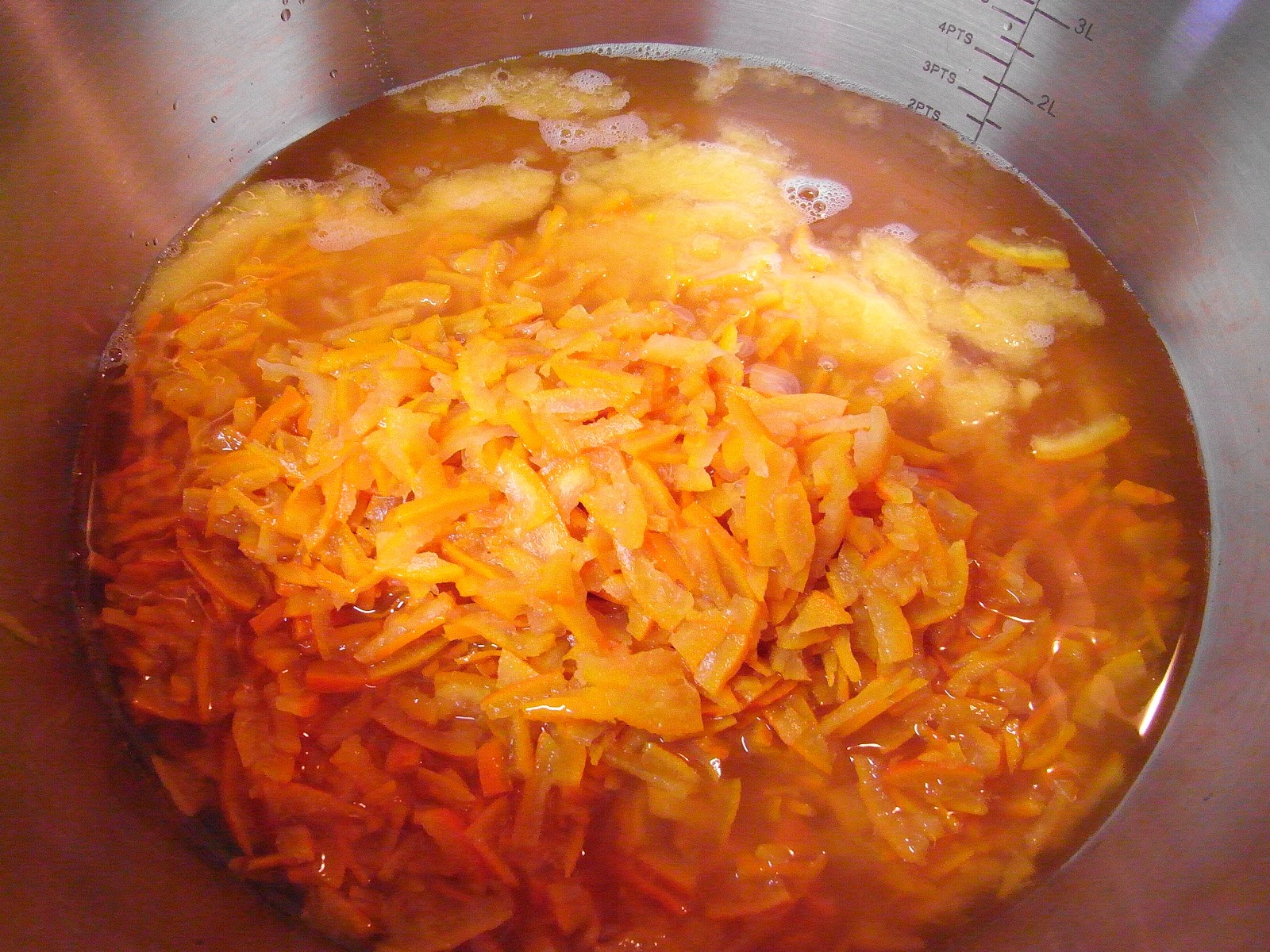
Put all the chopped bits of peel in a large container, add the water, and add muslin bag.  I used a three litre deep rectangular plastic box with lid.  I then put the jug with juice on top of everything within the box, which means the bag of bits gets pushed under, put the lid on, and left it all to seep for 24 hrs.  This softens the peel and allows a lot of pectin from the peel and pips to leach out into the water.

Once the soaking has taken place, put all the contents except for the jug of juice, into the pressure cooker, bring quickly to pressure and cook for 14 minutes.  When it is down to room pressure, you may start the remainder of the process, or you could leave this for another few hours.  Take the unopened muslin bag with its contents, and in a big sieve balanced over a bowl, twist the top, and press with a large spoon, to extract as much as the juice as possible.  The other alternative is to open the bag, put the contents in a sieve, and using a spoon, try to pass a fair quantity of gooey pulp into a bowl, which is then added to the preserving pan.

I like to add the juice only after the oranges are cooked at the final stage when using the large preserving pan to boil up the fruit and sugar, as thisgives  a fresher flavour to the marmalade.

Weigh the sugar in a large preserving pan.  The pressure cooker is likely to be too small to allow for the rise in the boiling marmalade.  Add the fresh juice together with the contents of the pressure cooker.  Continue to make your marmalade in the usual way.

This batch was made with just lemon juice and no peel, along with Sevilles


The chopped lemon peel gives a marmalade with two different coloured peels.  The pith on the lemon remains a little more opaque, obvious in the picture below.

The lemon peel from the other batch was used to make crystallized lemon peel to add to one of our favourite breakfast buns: lemon and ginger buns, which I have made at least five times!



Sunday, 9 April 2017

Seville 2017

During the first week in April...it may be as warm here in Wells as it is in Seville...I have to keep reminding myself that it is April and not May or June!

We have finished the last of the 2016 Vintage of Seville Marmalade, which was made from 2015 oranges...so it was time to make a new batch this weekend.  The Seville Oranges have been in the freezer for just a few weeks, and with some lovely fresh unwaxed lemons, I got 1 Kg fruit out to defrost on Friday.  Normally I would cook the fruit whole and cut after cooking, but this time, having felt the defrosted fruit, found that they were quite soft.  I chopped the peel finely, and added it to the 1 litre water in the pressure cooker, wrapped the segments and seeds in a muslin cloth and put that in the water too.  The whole lot was left to macerate till this morning.

I cooked up the fruit for 12 minutes in the New Pressure Cooker...12lbs pressure, they squeezed the bag of pulp and pips, and then added the sugar, and followed the usual boiling up, testing of temperature and also saucer test.  Can you see my new toy?  Well toy it is not...this is my new SuperFast Thermapen...what a boom, it takes just a few seconds to give an accurate read out.  It is MADE IN ENGLAND!  My old probe has lasted over twenty years...but you  had to hold it in the jam for ages as it took so long to get a reading!  It was my breadmaking friend Nigel who first showed this instrument to me via Facebook, for testing that bread was done...and I was hooked!

This year I have decided to make a preserve with less sugar...to 1 Kg fruit, I added the juice of two lemons, and 1.5Kg sugar, rather than 2Kg.

Most of the jars finished off as a classic Seville Marmalade...but I could not resist a little whiskey in two smaller jars!  Will Mr M who definitely does not like whiskey take to the Whiskey Marmalade?

Classic and Whiskey Seville Marmalade

Monday, 8 October 2012

Seville Marmalade Back to Basics

Using my very old tried and tested technique, I took some oranges out of the freezer, weighed them, put them in the pressure cooker whole with the water, and allowed them to thaw overnight.  The next day I cooked them, leaving till the third day, when they were removed, cut very finely, the pulp and pips sieved.  The remains are then cooked again to extract all the pectin with the remainder of the water.  Finally the lemon juice and warmed sugar is added. 


.


After ten minutes or so, the marmalade is ladled into the sterilised jars.  Usually I try to design and get the jars stored away in a dark cupboard the following day.

Sunday, 4 September 2011

Working on prize winning Marmalade

They say you should not count your chickens till they have hatched...but if you want the eggs to hatch, you can follow best practice to ensure the best outcome...

Each of my batches of preserves in the past has been made with the same care and attention, so when it comes to competition time, I just go through my preserve cupboard, and select a pretty jar. This January though, I did not make enough to last me through, or maybe I gave a few too many jars away, so for the Marmalade section, I need to make a new batch....


Here is the batch coming up to the gentle roll stage.

The best outcome would have been with fresh Seville Oranges, but at this time of the year, I have only 0.75Kg of frozen ones to work on. However fresh juicy lemons, and my favourite brand of sugar, careful preparation, cooking, and testing, and my fingers are crossed that the judge will be of the same opinion as me!


In addition to spreading on toast, I use marmalade in cooking: to finish off pan fried duck breast as a sauce with rosemary, and port, in bread and butter pudding, in fruit cake etc....


With my registration papers from Warwickshire came all the guidance notes, and one was that there should be sufficient extraction to prevent moisture build up in the premises....can't say that I had a premonition about this venture, when we had an extractor hood fitted a few months ago...but it is a boom when they is so much simmering and boiling taking place. I prefer to have the doors and windows closed until the preserve is potted up, to prevent wasps and such like being attracted by the smells. Afterwards the whole house gets a blow through.